Produce and sell eco-friendly and reliable disposable paper food packaging products for global customers!
Language
Produce and sell eco-friendly and reliable disposable paper food packaging products for global customers!
3M's 7.35BPFASSettlementandPFAS−FreePackaging∗∗Metadescription:∗∗3Mwillpayupto7.35BPFASSettlementandPFAS−FreePackaging∗∗Metadescription:∗∗3Mwillpayupto7.35 billion over nine years to settle PFAS injury claims. What the deal and the new packaging rules mean for foodservice buyers.
On November 3, 2026, 3M announced a broad resolution of the PFAS personal injury claims at the centre of the Aqueous Film-Forming Foam (AFFF) litigation in South Carolina: **7.35billionovernineyears∗∗,apresentvalueof7.35billionovernineyears∗∗,apresentvalueof5.8 billion.
•Covers roughly 99% of current PFAS injury claims, about 115,000 to 120,000 plaintiffs
•$680 million reserve held for remaining and future claims
•Paid through 2034: $50 million in 2026, nothing in 2027, about 20% in the final two years
•Not an admission of liability, per 3M
It sits alongside 3M's 2023 settlement with US public water suppliers — up to $10.3 billion over 13 years, approved by the court in 2024. The company also confirmed it completed its exit from all PFAS manufacturing globally by the end of 2025.
Why a firefighting foam case matters to a paper bowl buyer
The chemistry that smothered fuel fires is the same chemistry that made paper packaging resist grease: a fluorochemical treatment drops surface energy so oil beads off instead of soaking in.
That use has now been regulated out, market by market:
•US federal. On 28 February 2024 the FDA confirmed PFAS are no longer sold for grease-proofing food packaging in the US market.
•US states. At least twelve states now restrict intentionally added PFAS in food packaging or foodservice ware, including California, New York, Minnesota, Washington and Maine, whose plant-fibre rule took effect on 25 May 2026.
•EU. The REACH restriction on PFHxA applies to most consumer uses from 10 October 2026, with longer transitions for some product groups.
The operative phrase is intentionally added. That puts the burden of proof on the supplier, not the regulator.
Four questions for your packaging supplier
"PFAS-free" is not a defined legal term, so specify the evidence rather than the claim:
•Scope. "No intentionally added PFAS" is a declaration; "total organic fluorine below X ppm" is a measurement. Ask for both.
•Method and detection limit. Total organic fluorine by combustion ion chromatography for screening, targeted analysis (e.g. EN 17681-1/-2) for characterisation. A result without a detection limit is not a result.
•Lot-level data. Base paper, barrier coating and printing inks are three inputs. Which was tested, on which lot, when?
•Barrier performance. Grease resistance as a kit rating, water resistance as a Cobb value, plus a stated holdout time at serving temperature. A coating that passes a fluorine screen but fails a two-hour grease test has solved compliance by creating an operational problem.
How KaiLai approaches it
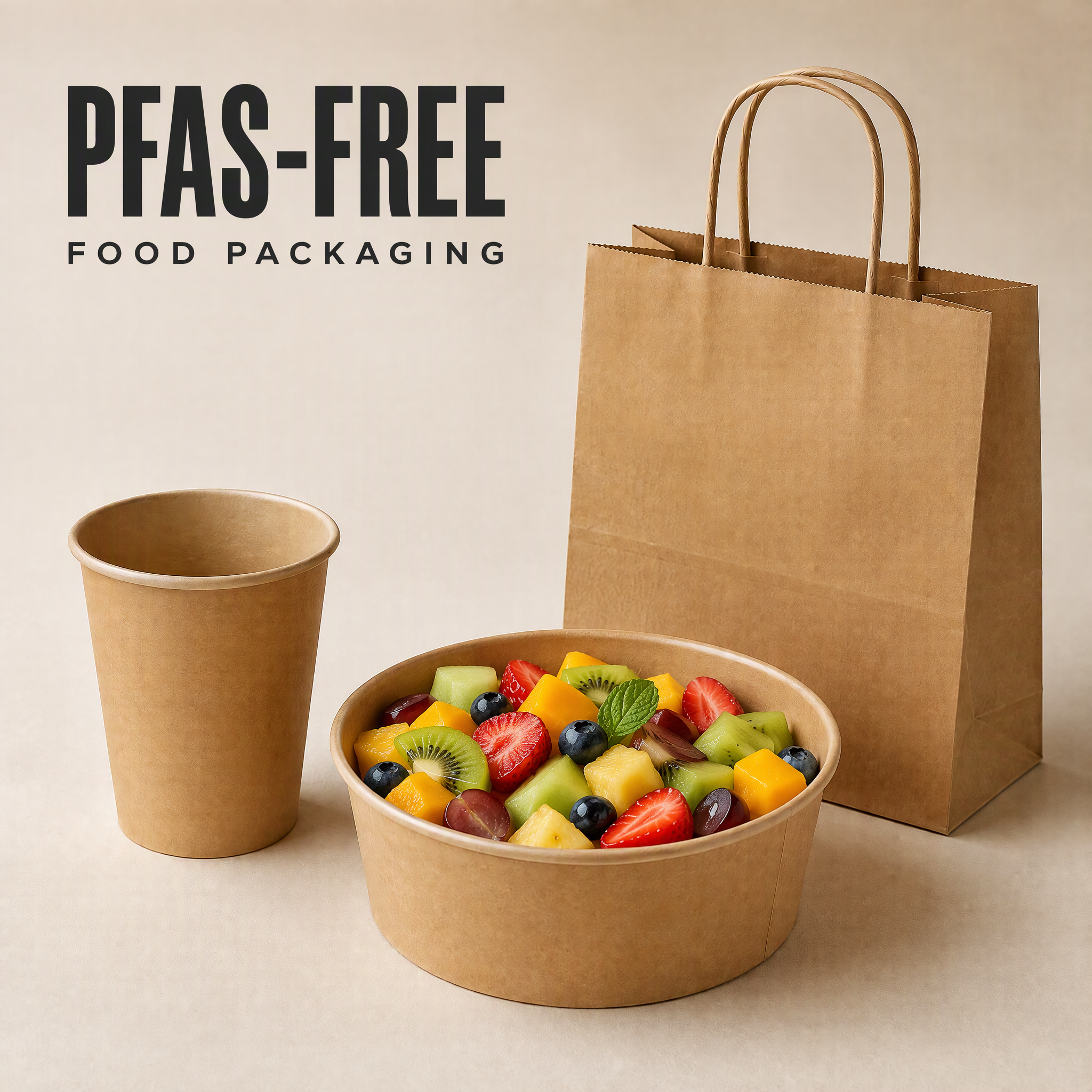
KaiLai's paper cups, bowls and bags use a bio-based polyester dispersion coating rather than a fluorochemical grease barrier, so oil and water holdout come from film formation rather than surface chemistry. Ask us for the coating specification and the food-contact documentation for your market.
Recommended
Kai Lai Packaging Produce and sell environmentally friendly and reliable disposable paper food packaging products for global customers.